
Introduction
The intersection of shifting federal immigration policies and administrative backlogs has created a critical healthcare vulnerability for hundreds of thousands of humanitarian migrants living in the United States. Under the 2025 reconciliation law, federally funded health coverage was systematically eliminated for refugees and asylees who do not yet hold a green card, alongside several other groups of lawfully present immigrants.
Because federal regulations generally restrict eligibility for programs like Medicaid, the Children’s Health Insurance Program (CHIP), subsidized Affordable Care Act (ACA) Marketplace plans, and Medicare to lawfully present immigrants who possess Lawful Permanent Resident (LPR) status—commonly known as a green card—the administrative speed at which U.S. Citizenship and Immigration Services (USCIS) processes these applications has become a matter of healthcare access and medical security. Refugees and asylees are permitted to apply for LPR status after living in the United States for one year, or one year after being officially granted asylum. Consequently, USCIS processing efficiency directly dictates whether these vulnerable populations can maintain or secure essential medical coverage.
A comprehensive analysis of USCIS data highlights alarming trends in green card (Form I-485) application processing for refugees and asylees between fiscal year 2021 and fiscal year 2026. The data reveals a dramatic slowdown in application completions, a sharp drop in completed applications as a share of total caseloads, and a massive surge in processing times. As a result, more than 275,000 pending green card applications from refugees and asylees remain stalled, leaving applicants exposed to prolonged periods without access to federally funded health coverage as they await final decisions from federal immigration authorities.
Background on Humanitarian Protections and Policy Shifts
Since 1980, the United States has operated a formalized system for welcoming refugees and asylees—individuals and families forced to flee their homelands due to a well-founded fear of persecution based on race, religion, nationality, membership in a particular social group, or political opinion. The legal right to seek asylum is firmly rooted in international law, and the domestic refugee program reflects a longstanding commitment to humanitarian protection as a core tenet of American immigration policy.
Individuals granted refugee or asylum status typically arrive in the United States having experienced severe trauma in their countries of origin or during their arduous journeys. Many arrive with few or no personal resources. Historically, the federal government provided essential transitional assistance, including aid for food, housing, and healthcare, alongside other time-limited integration services. However, recent policy adjustments implemented by the Trump administration have significantly restricted the entry of humanitarian migrants. These measures have included pausing refugee applications, setting historically low numerical ceilings for refugee admissions, and implementing administrative restrictions that have effectively closed the southern border to most individuals seeking asylum.
Under federal statute, individuals who arrive as refugees or who have been formally granted asylum are eligible to apply for an adjustment of status to LPR by filing Form I-485, the Application to Register Permanent Residence or Adjust Status, after completing one year of physical presence in the country. It is vital to distinguish that individuals whose asylum applications are still pending adjudication are not classified as asylees and therefore remain ineligible to apply for a green card, regardless of how long their cases take to wind through the immigration court or asylum office systems.
The landscape shifted dramatically with the enactment of the 2025 reconciliation law, which stripped refugees and asylees of their historic exemption from public assistance restrictions. Standard federal policy mandates that most lawfully present immigrants, including the vast majority of new LPRs, must wait five years after acquiring a "qualified" immigration status before enrolling in federally funded programs like Medicaid and CHIP. Historically, refugees and asylees were explicitly exempted from this five-year waiting period, provided they met income guidelines and state-level eligibility criteria. Furthermore, they were permitted to enroll in subsidized ACA Marketplace coverage and Medicare.
The 2025 reconciliation law dismantled these provisions, stripping eligibility for Medicaid, CHIP, subsidized Marketplace plans, and Medicare from refugees and asylees who lack a green card, as well as from certain other categories of lawfully present immigrants. While narrow exceptions exist in states utilizing specific Medicaid or CHIP options to cover lawfully residing children and pregnant individuals, the broader restrictions took effect for Medicaid and CHIP on October 1, 2026, with Marketplace and Medicare restrictions taking full effect in January 2027. Projections from the Congressional Budget Office indicate that these eligibility barriers will drive approximately 1.4 million lawfully present immigrants into the ranks of the uninsured by 2034.
Trends in Processing Green Card Applications for Refugees and Asylees
An examination of federal data reveals distinct trajectories in the volume of I-485 applications received by USCIS. Between fiscal year 2021 and fiscal year 2025, the number of green card applications received for refugees surged by 274 percent, climbing from 22,906 to 85,743. Over the same period, applications received for asylees grew by 68 percent, rising from 44,837 to 75,292. The relatively lower application volumes recorded in fiscal year 2021 can largely be attributed to pandemic-related disruptions that curtailed international migration and refugee processing.
However, a divergence emerged when comparing the first three quarters of fiscal year 2025 to the corresponding period in fiscal year 2026. While refugee applications continued to edge upward by roughly 10 percent—moving from 59,754 to 66,013—applications from asylees dropped by approximately 32 percent, falling from 58,682 to 40,344. This contraction aligns directly with broader administrative policy changes, such as the reduction of the refugee admissions cap from 125,000 in fiscal year 2025 down to 7,500 for fiscal year 2026, alongside restrictive border policies implemented across multiple administrations that sharply limited new asylum adjudications.
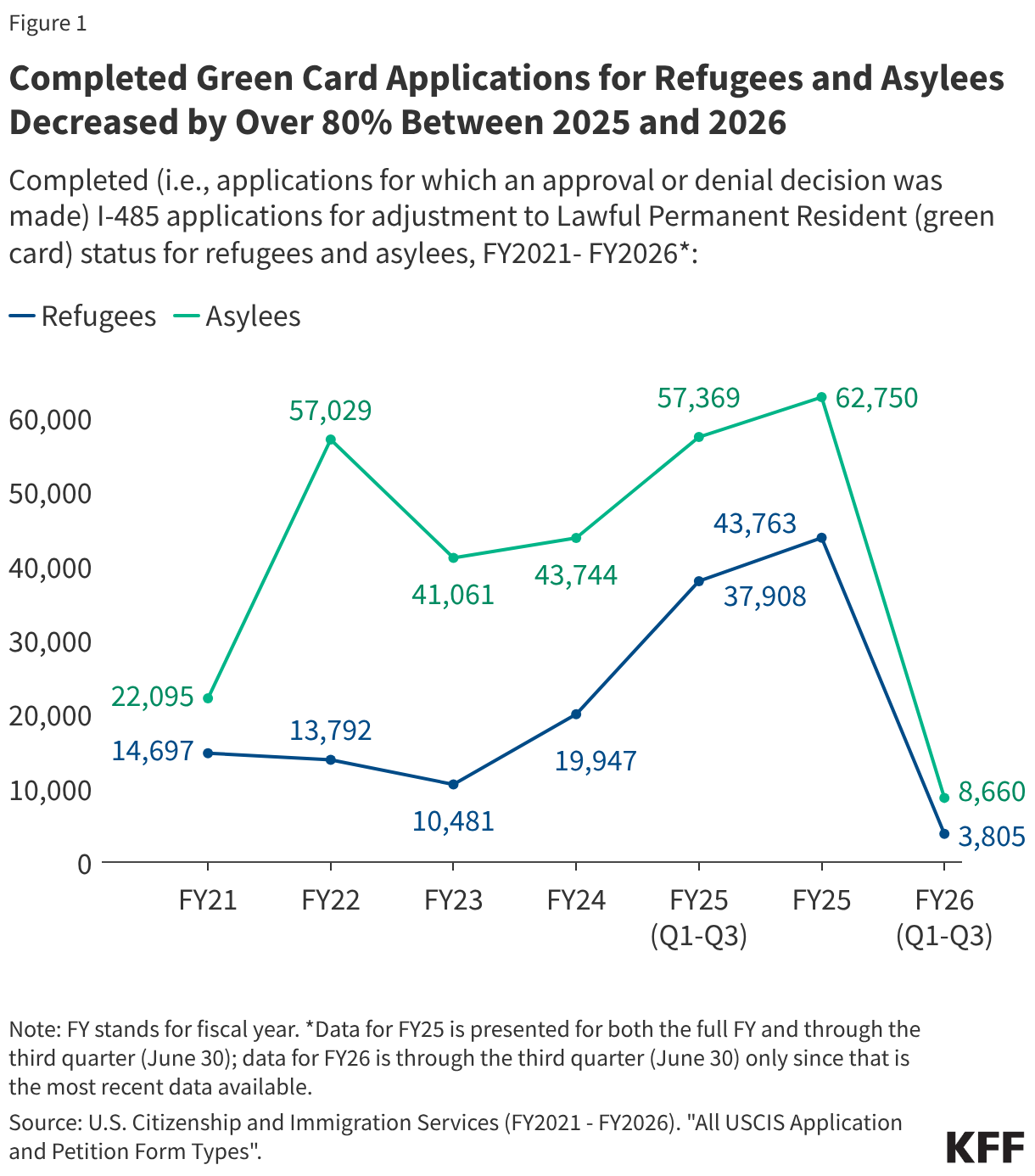
More pronounced than the shifts in incoming application volume is the dramatic collapse in application completions by USCIS. Between fiscal year 2021 and fiscal year 2025, the number of completed I-485 applications—defined as those resulting in a formal approval or denial decision—rose significantly, increasing by 198 percent for refugees, from 14,697 to 43,763, and by 184 percent for asylees, from 22,095 to 62,750.
This productive momentum reversed sharply in fiscal year 2026. Comparing the first three quarters of fiscal year 2025 to the same timeframe in fiscal year 2026, USCIS completions dropped by roughly 90 percent for refugees, plunging from 37,908 to just 3,805. Completions for asylees experienced a similar catastrophic decline of approximately 85 percent, falling from 57,369 down to 8,660.
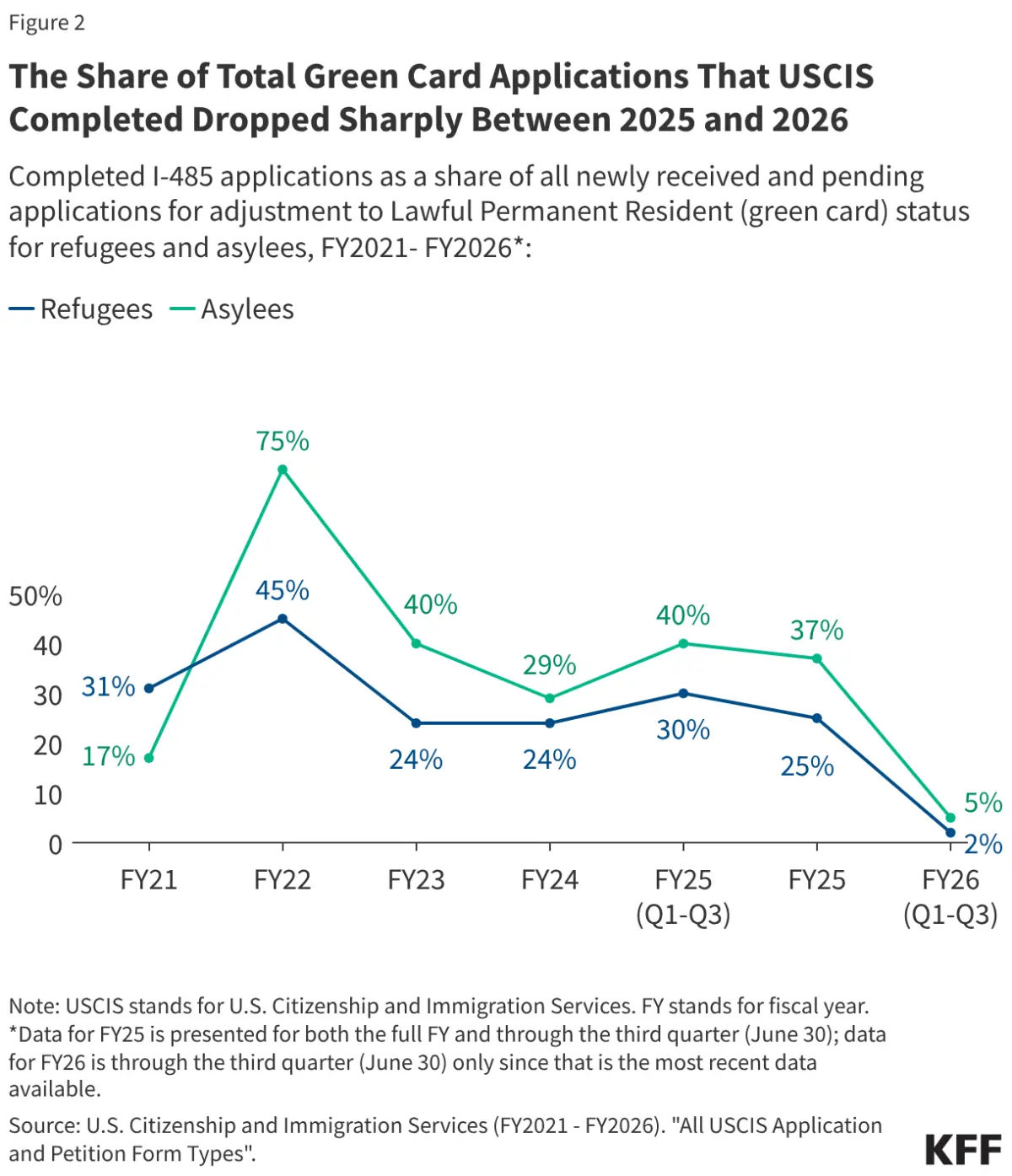
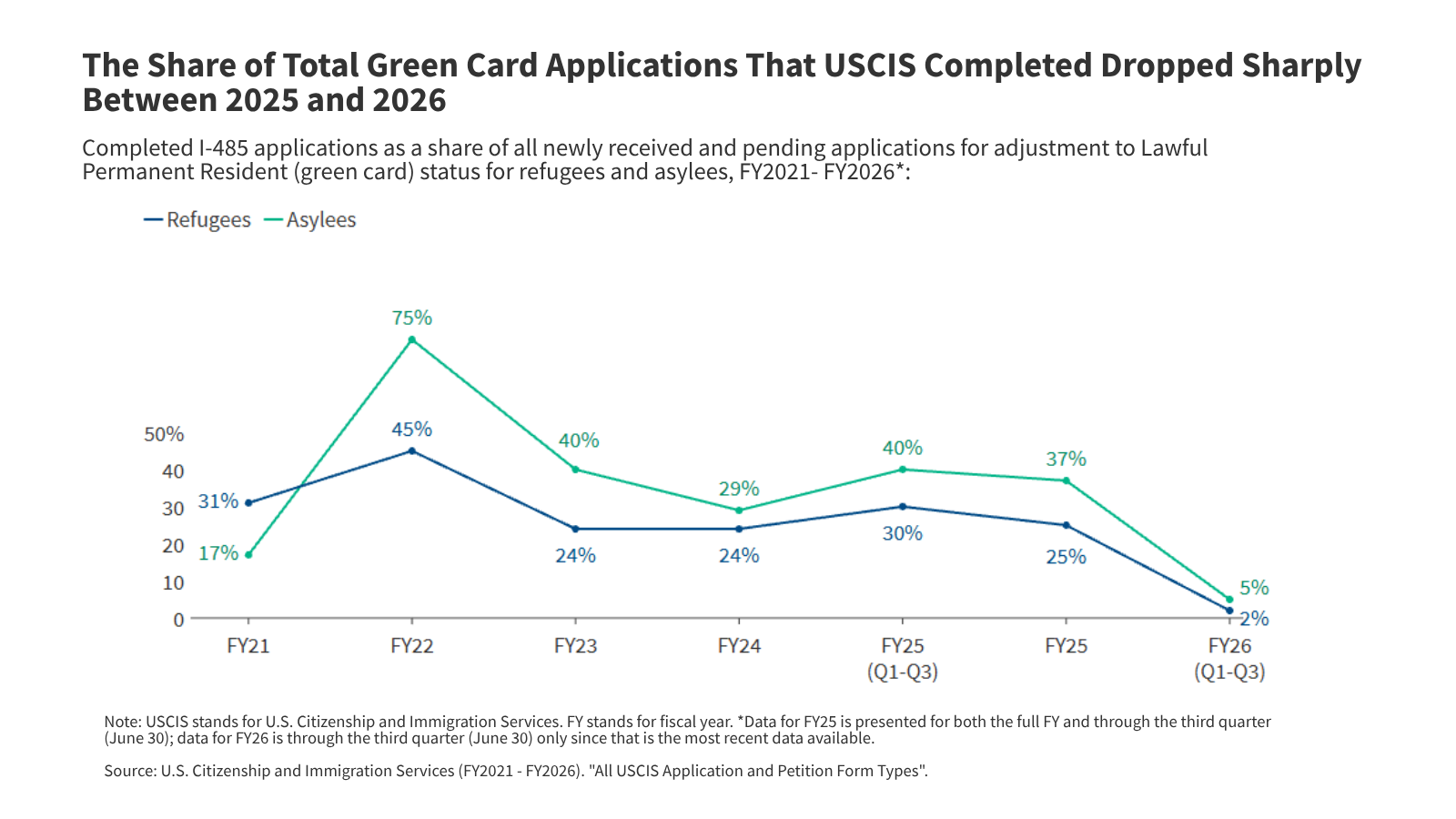
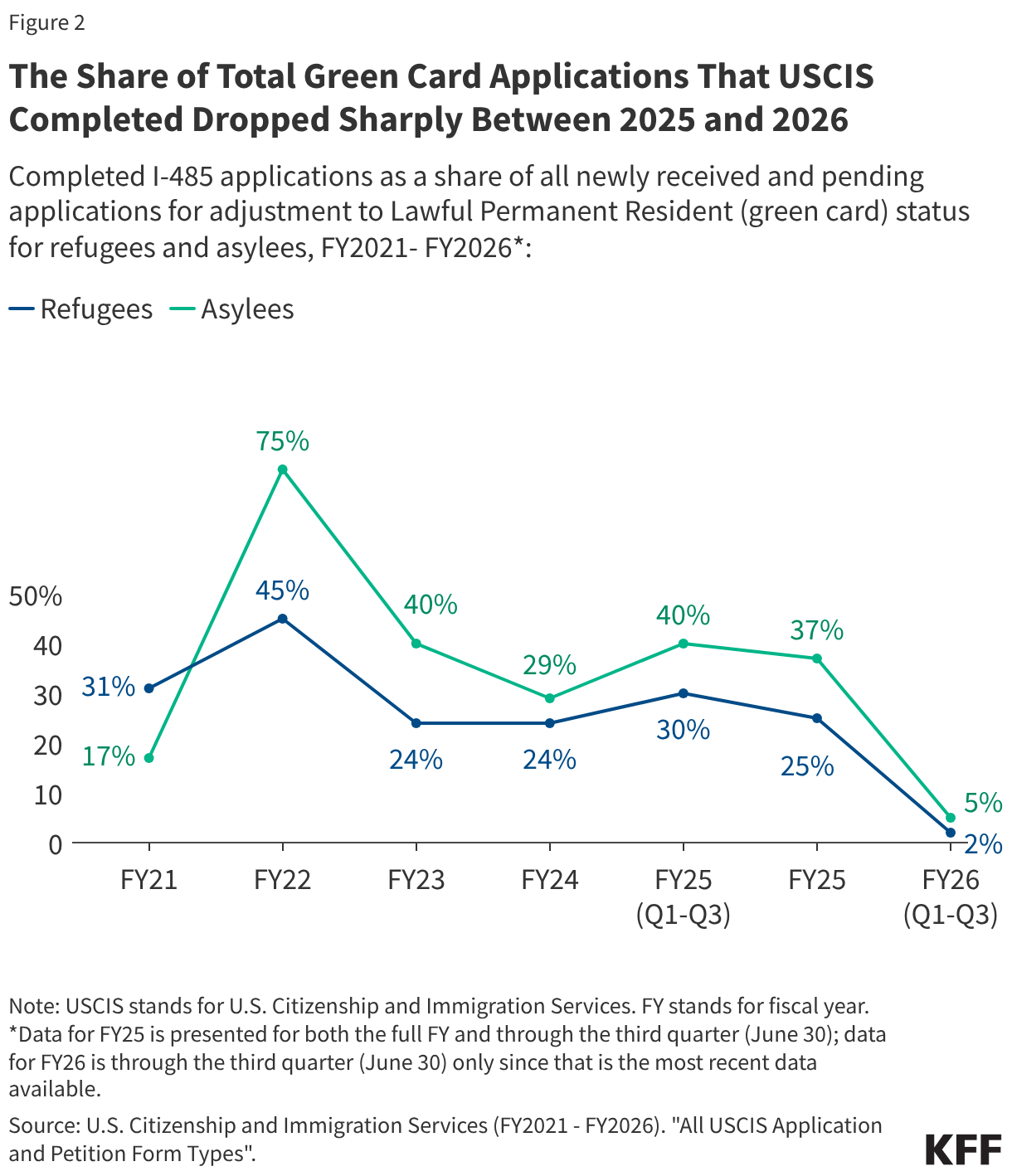
This contraction is further illustrated by examining completed applications as a share of the total active caseload, which includes both newly received and lingering pending petitions. Between fiscal year 2021 and fiscal year 2025, the proportion of applications completed by USCIS shifted from 31 percent to 25 percent for refugees, while rising from 17 percent to 37 percent for asylees. By contrast, across the first three quarters of fiscal year 2026, the completion share plummeted to an astonishingly low 2 percent for refugees and 5 percent for asylees.
Consequently, the backlog of pending green card applications has swelled to unprecedented levels. As of the end of fiscal year 2025, pending refugee applications stood at 87,573—representing a 251 percent increase from 24,983 at the close of fiscal year 2021. Pending asylee applications grew more modestly over that initial multi-year span, rising 7 percent from 87,997 to 94,482.
However, the slowdown in fiscal year 2026 caused the backlog to skyrocket. Between the third quarter of fiscal year 2025 and the third quarter of fiscal year 2026, pending applications surged by 121 percent for refugees, growing from 67,502 to 149,470. For asylees, pending petitions jumped by 51 percent, from 83,446 to 126,267. This brought the combined total of pending green card applications for refugees and asylees to 275,737 as of June 30, 2026, a figure expected to climb further by the close of the fiscal year.
This administrative bottleneck has translated directly into severely extended processing times. Between the first three quarters of fiscal year 2025 and the same period in fiscal year 2026, the average processing time for a refugee green card application nearly doubled, expanding from 7.8 months to 13.3 months. For asylees, the average processing time jumped from 10.7 months to 19.9 months.
An intra-year examination of fiscal year 2026 underscores a compounding deterioration in agency performance. The average processing timeline for refugees more than doubled over the course of three quarters, rising steadily from 7.6 months in the first quarter to 17.6 months by the third quarter. For asylees, the situation deteriorated even further, with average processing timelines climbing from 12.1 months in the first quarter to an alarming 25.6 months by the third quarter.
With green card applications taking well over a year—and in many cases nearly two years—to adjudicate, thousands of refugees and asylees who have already fulfilled their legal requirement to apply for permanent residency find themselves caught in an administrative limbo. As the new federal restrictions strip away their traditional eligibility for safety-net health programs, these prolonged processing delays mean that individuals fleeing persecution will face extended periods without access to essential medical care while awaiting decisions from USCIS.








No comments yet. Be the first to join the conversation!