

The United States government is fundamentally reshaping its approach to international medical and humanitarian assistance through the rollout of its "America First Global Health Strategy." Originally unveiled in late 2025 and updated continuously through October 2026, the strategy introduces a new framework of bilateral health cooperation agreements designed to transition partner nations away from reliance on U.S. funding toward sustainable, domestic long-term health system ownership.
Under this strategic overhaul, the U.S. has established binding Memorandums of Understanding (MOUs) and similar strategic pacts with nations that traditionally receive U.S. global health assistance. These bilateral arrangements function as structured five-year plans spanning the 2026 through 2030 period. They outline the precise scope of U.S. diplomatic and programmatic engagement in each partner country’s domestic health sector, aiming to foster more resilient, self-sufficient healthcare infrastructures.
Central to these new bilateral agreements is a mandatory co-investment model. Partner countries that sign the MOUs pledge to systematically increase their own domestic health spending over the designated five-year timeline, running parallel to a planned tapering of direct U.S. health assistance. The U.S. government began formalizing and signing these accords in late 2025, a continuous diplomatic process slated for full global implementation.

To monitor the progression and financial parameters of these diplomatic undertakings, specialized data tracking initiatives have synthesized information drawn directly from official press releases issued by the U.S. Department of State, various U.S. embassies, and the Ministries of Health of partner countries, alongside public MOU documentation.
Current tracking metrics indicate that 36 countries have finalized these agreements with the United States. However, the structural composition and duration of the pacts vary slightly depending on regional agreements. While the vast majority adhere to standard five-year plans, bilateral global health agreements established with Bolivia, Botswana, Panama, and South Sudan are structured for a shorter, three-year period. Furthermore, diplomatic engagements have occasionally taken alternative legal formats; for instance, the Philippines did not sign a traditional MOU but instead executed a "Strategic Objective Agreement" outlining collaborative health goals.

Financial disclosures surrounding the agreements reveal significant shifts in international funding dynamics. Across the 36 countries that have successfully concluded agreements with the U.S., a macro-level comparison between historical funding—comprising appropriated and planned amounts for Fiscal Years 2021 through 2023, alongside requested amounts for Fiscal Years 2024 and 2025 under the Global Health Programs (GHP) account—and the newly proposed five-year MOU funding demonstrates a substantial reduction. Collectively, U.S. global health funding across these specific countries is projected to decrease by approximately $8.1 billion, representing a 34 percent decline compared to historical figures.
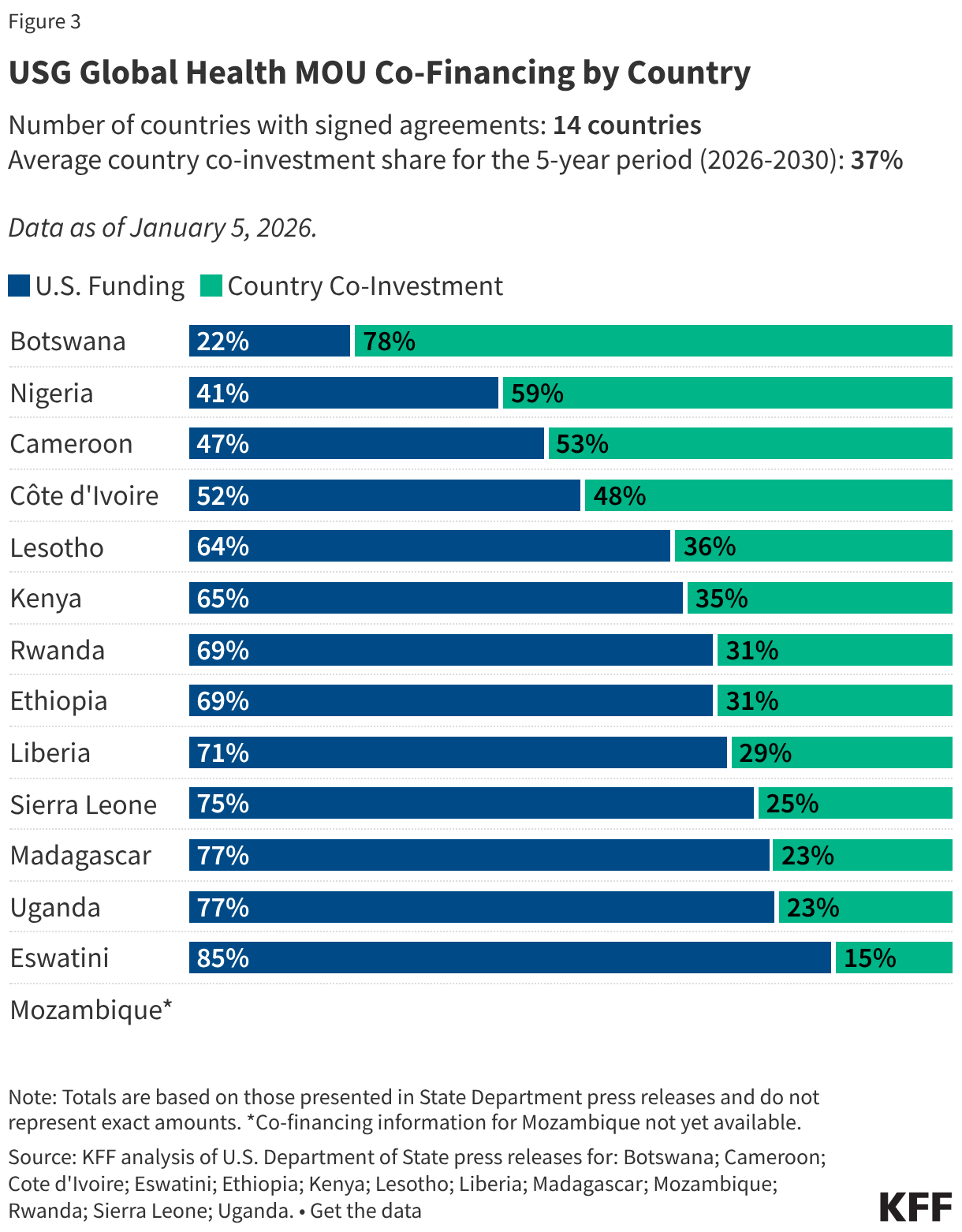
This reduction aligns directly with the core premise of the America First Global Health Strategy: decreasing direct foreign outlays while catalyzing a massive surge in domestic health co-investments from partner governments. For example, while U.S. funding commitments under individual country MOUs have dropped, recipient nations are expected to bridge the gap by scaling up local health budgets.
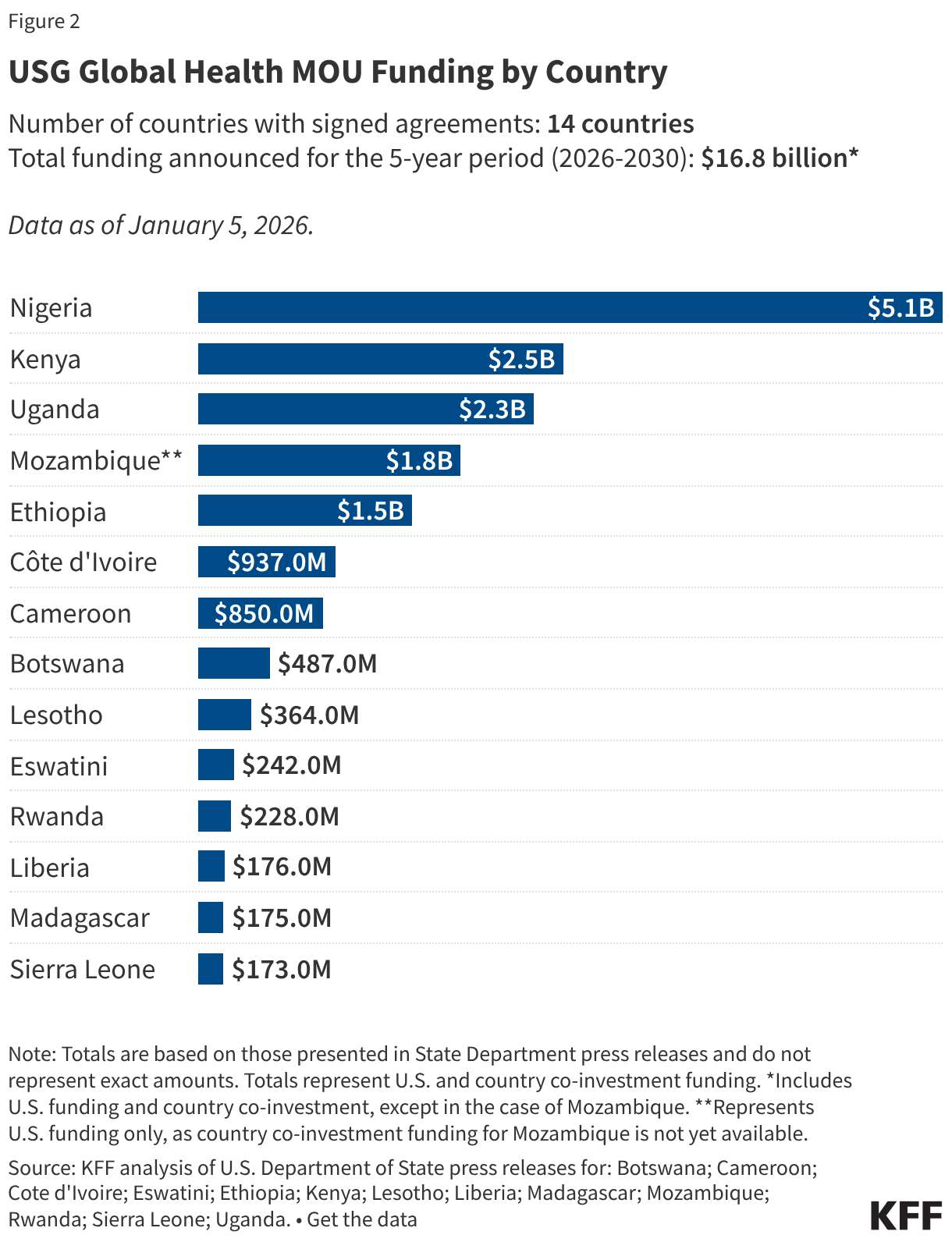
The financial transparency of these agreements, however, varies by region due to the availability of source documents. For most participating nations, detailed funding data and co-financing shares are sourced directly from the full text of the signed MOUs. Notable exceptions include Malawi, where financial parameters are derived from Department of State press statements, and nations such as Vietnam and the Philippines, where complete co-financing breakdowns remain publicly opaque. In Vietnam, for instance, the U.S. announced a direct allocation of $98.75 million for its MOU, while official State Department disclosures indicate that Vietnam’s annual domestic health expenditure is projected to grow by approximately $10.5 billion over the five-year MOU period, rising from $23.3 billion to $33.8 billion. Similarly, while the Philippines has secured an overall funding amount through its Strategic Objective Agreement, granular domestic co-financing details have not yet been made public.
Beyond pure financial re-allocations, the bilateral agreements target a diverse array of programmatic health areas tailored to the specific vulnerabilities and developmental needs of each partner nation. These span foundational medical sectors, including maternal and child health, infectious disease control, health workforce strengthening, and global health security.
Methodological frameworks utilized to classify these program areas rely primarily on keyword searches of available diplomatic texts and public statements. For global health security specifically, country agreements are categorized as targeting health security if they explicitly reference the term or detail robust operational plans for outbreak preparedness, rapid response activities, and the containment of emerging domestic and regional health threats. Because many signed agreements remain partially confidential or are summarized exclusively through high-level diplomatic press releases rather than full legal texts, analysts note that these tracking figures may not comprehensively capture every niche programmatic focus embedded within individual country pacts.
As the implementation phase of the America First Global Health Strategy continues to unfold, monitoring mechanisms managed by policy and global health research organizations will persist in updating their oversight databases. These ongoing reviews aim to capture newly signed agreements, track the execution of country-specific co-financing commitments, and evaluate whether partner nations successfully achieve the long-term health system resilience and self-reliance envisioned by the bilateral frameworks.











No comments yet. Be the first to join the conversation!