
As federal and state agencies prepare for sweeping policy shifts regarding public assistance, the intersection of work requirements and medical exemptions is drawing intense scrutiny. Long standing as a cornerstone of the Supplemental Nutrition Assistance Program (SNAP), work mandates are soon set to expand into the Medicaid program for certain adult enrollees. Beginning January 1, 2027—or sooner if states choose to accelerate implementation—44 states will be required to condition Medicaid eligibility for adults in the Affordable Care Act expansion group, as well as enrollees in specific waiver programs, on meeting strict work requirements.
However, the impending transition has brought administrative complexities to the forefront, particularly regarding how states will verify exemptions for individuals who are medically frail. While federal law mandates exclusions for those with qualifying conditions that impair their ability to work, the mechanisms for verifying these exemptions remain varied and uncertain. To understand the challenges ahead for Medicaid, policy analysts and state administrators are increasingly looking to the historical framework of the SNAP program, which has navigated similar operational hurdles for decades.
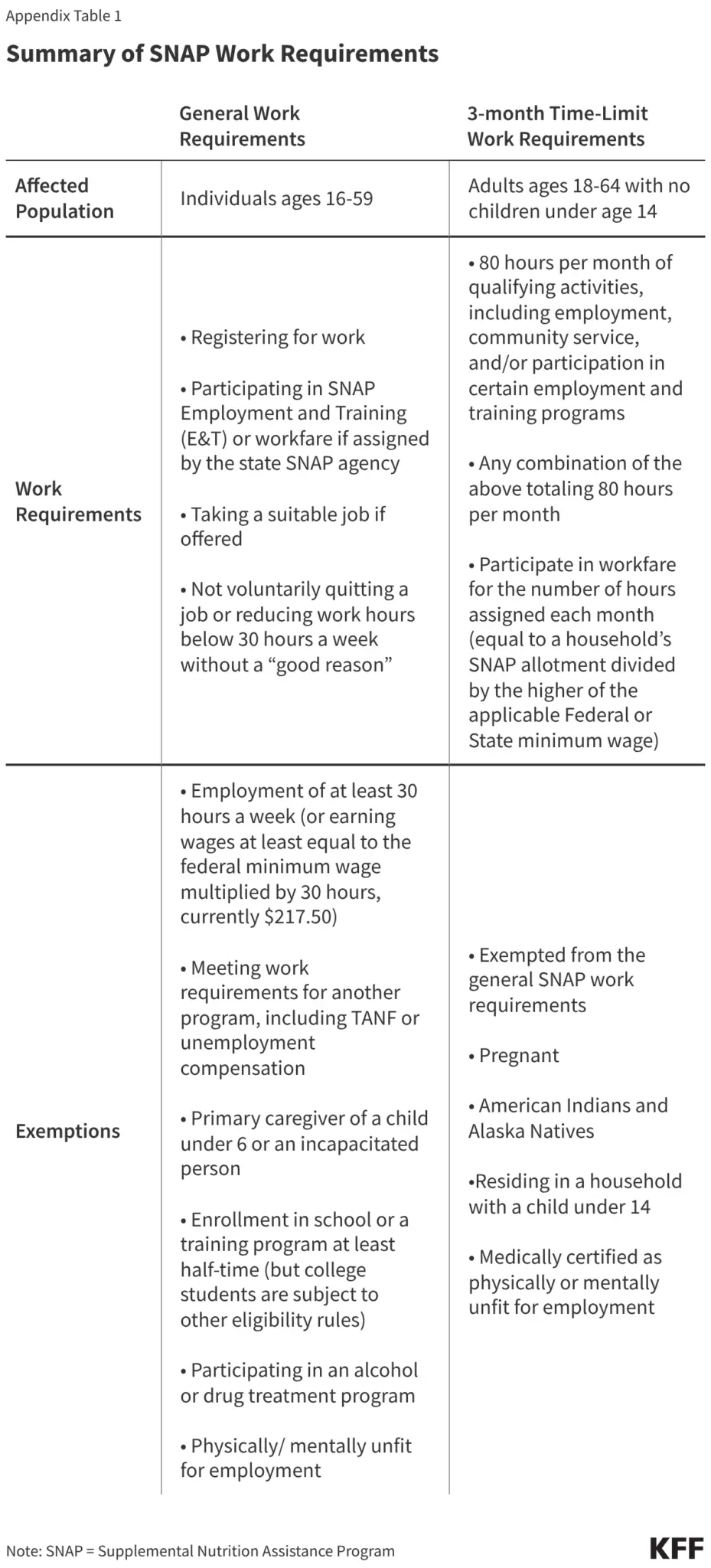
The Supplemental Nutrition Assistance Program, recognized as the primary federal aid initiative addressing food insecurity among low-income households, has long incorporated work mandates as a condition of participation. Alongside general work rules, "time-limited" requirements apply to certain adults who must work, participate in a work program for at least 80 hours per month, or fulfill workfare obligations to maintain benefits for more than three months in a 36-month period. Crucially, both general and time-limited mandates exempt individuals who are deemed physically or mentally unfit for employment.
How Have States Historically Determined Ability to Work for the SNAP Program?
Federal regulations grant state agencies broad flexibility in defining what constitutes a physical or mental limitation and in establishing verification procedures for SNAP work exemptions. Rules regarding time-limited work requirements offer slightly more specific definitions, but the overarching discretion is left to state administrators. Consequently, definitions vary widely across the country. Some states maintain more expansive interpretations of physical or mental limitations, choosing to include chronically homeless individuals or survivors of domestic violence when these challenging circumstances severely impact their physical or mental health. Furthermore, states are federally mandated to exempt anyone receiving temporary or permanent disability benefits, including Supplemental Security Income, Worker’s Compensation, Veteran’s Affairs benefits, Railroad Retirement, or developmental disability services, though the documentation and verification processes for these statuses still vary by jurisdiction.
To manage these exemptions, a mandatory component of the SNAP application and recertification process involves a phone or in-person interview with an eligibility worker who screens enrollees. Data from recent years indicates that most states first screen for physical or mental limitations directly on the application, while others rely on the required interview. Over half of state agencies also report allowing individual staff members considerable discretion over the types of limitations they may consider for exemptions, such as noting visual observations like an enrollee using an oxygen tank during an interview.
When determining whether someone is obviously unfit for work, state practices diverge significantly. Some jurisdictions invariably require formal medical documentation of an individual’s limitations, whereas many others accept client statements unless an eligibility worker finds the situation questionable or unclear. Evaluations of SNAP work exemption processes have highlighted the competing perspectives surrounding this discretion. Some eligibility workers suggest that uniformly requiring documentation reduces staff burden and subjective decision-making by fostering consistency. On the flip side, routinely demanding medical paperwork substantially increases the administrative burden for enrollees, healthcare providers, and eligibility workers who must process the documents and occasionally seek further clarification. Because individuals must be reevaluated at recertification intervals every six to twelve months, and studies show that information collected at renewal rarely differs from the initial application, these administrative bottlenecks persist.
When an unfitness to work is not immediately obvious to an eligibility worker, states are required to obtain a statement from a licensed medical professional to verify exemption status. Even so, the specific procedures for collecting provider attestations vary widely. The information requested from medical providers ranges from simple check-box forms to detailed narrative descriptions of functional capacity. Providers themselves are rarely provided with detailed regulatory guidance on how to assess fitness for work, meaning their determinations regarding who qualifies for an exemption can be highly inconsistent.
Compounding these administrative choices, state SNAP agencies may soon overhaul their verification processes in response to a major new federal mandate. Under recent reconciliation legislation, states will be required beginning in October 2027 to pay a portion of SNAP benefit costs if their payment error rate exceeds six percent. Because payment error rates measure administrative over- and underpayments rather than deliberate fraud, states are rebalancing their verification strategies. Historically, states balanced the need for program integrity against the administrative burdens placed on enrollees. Now, faced with steep financial penalties tied to error rates, some states are tightening rules. For instance, Arizona recently moved to require additional documentation for information where client self-attestation was previously accepted, illustrating how financial risk can drive shifts in administrative policy.
How May the Medicaid Process Compare to SNAP?
As states prepare for the rollout of Medicaid work requirements, the process for verifying the medical frailty exclusion is expected to diverge from SNAP in several fundamental ways, largely due to the availability of health data. Unlike SNAP agencies, state Medicaid programs possess extensive administrative databases, including comprehensive claims and encounter data from healthcare providers.
An interim federal rule released by the Centers for Medicare & Medicaid Services instructs states to utilize claims and encounter data from the preceding 12 months to attempt to verify an individual’s medical frailty status automatically before ever requesting documentation from the enrollee. CMS has outlined a tiered medical frailty framework to guide this process. Under this approach, states can identify individuals as medically frail using claims data alone in the first tier, combine claims with encounter or other health data in the second tier, or resort to an individualized manual process requiring additional documentation in the third tier when existing data is insufficient or absent.
Despite the promise of automation, data limitations will inevitably require manual intervention. Factors such as a lack of historical data for new applicants, recent enrollees, or providers who fail to consistently code conditions using designated state categories mean that states will still need supplemental documentation for a portion of the population.
In situations where claims data is unavailable, Medicaid programs will likely rely on treating providers to verify medical frailty and work capacity, much like SNAP. However, because federal Medicaid rules prohibit standard eligibility interviews, eligibility workers will play a less prominent role in direct screenings. In states where SNAP and Medicaid programs are jointly administered or share data systems, Medicaid agencies may be able to leverage information gathered during SNAP interviews. Absent robust federal guidance on what specific information to collect from providers, states are expected to develop their own disparate forms, mirroring the historical fragmentation seen in SNAP. Some states are exploring unified solutions, such as North Carolina’s creation of a single provider attestation form that can be used to determine eligibility across both Medicaid and SNAP programs.
Another critical difference lies in the treatment of self-attestation. While SNAP rules permit client statements unless deemed questionable—subject to state discretion—Medicaid rules will heavily restrict reliance on self-attestation starting in January 2028. Although states may accept self-attestation throughout 2027 when reliable data is missing, the rules dictate that beginning in 2028, states may only accept a self-attestation of medical frailty status once during an individual’s enrollment period. For subsequent renewals, states must verify status through available data or require formal documentation from the enrollee, introducing a significantly more time-consuming verification process. This restriction marks a major shift, given that prior to the interim rule’s publication, a majority of state Medicaid directors had expressed strong interest in utilizing self-attestation to streamline the medical frailty exemption process.
Ultimately, state Medicaid verification policies will vary widely, shaped heavily by the looming threat of federal financial penalties. The Medicaid regulations specify that states could face findings of noncompliance if federal audits reveal frequent approvals of medical frailty status with insufficient evidentiary support demonstrating that a condition genuinely impairs an individual’s ability to work. Balancing the imperative to protect themselves from financial sanctions against the desire to minimize administrative hurdles and prevent wrongful coverage losses remains a formidable challenge for state administrators. These complex changes are taking place even as states prepare for stricter federal payment error rate measurement rules in Medicaid, which will heighten the financial consequences of eligibility errors exceeding three percent and further influence how states weigh administrative burdens against fiscal risk.







No comments yet. Be the first to join the conversation!