
WASHINGTON — In an unprecedented legal maneuver with potential ramifications nationwide, the U.S. Department of Justice filed a lawsuit on Thursday to intervene in the high-stakes U.S. Senate race in Alaska. The federal government is seeking to block the certification of the election results under specific conditions should Republican incumbent Senator Dan S. Sullivan lose his bid for re-election.
The extraordinary filing has ignited intense debate among legal scholars, voting rights advocates, and political leaders, many of whom are questioning whether the federal agency possesses any legitimate legal basis for the intervention. Analysts suggest the lawsuit may serve as an early preview of how the Trump Administration intends to respond should it face unfavorable midterm election outcomes across various states.
At the center of the controversy is a unique ballot configuration involving two candidates who share the same name. Republican Sen. Dan S. Sullivan is currently campaigning to defend his seat, while one of his prominent challengers is Daniel J. Sullivan. Although the challenger initially registered as a Republican, election officials altered his party affiliation listing on the ballot to help voters better distinguish between the candidates.
The Department of Justice argued in its court filing that there is a significant risk of "voter confusion" resulting from the identical names. The agency contends that the "sole purpose" of Daniel J. Sullivan’s candidacy is to siphon votes away from the incumbent and ultimately benefit his primary Democratic opponent, Mary Peltola.
Consequently, the lawsuit asks the court to block the official certification of the election if the incumbent senator loses the race but would have otherwise emerged victorious had all votes cast for Daniel J. Sullivan gone to him instead. To resolve this, the DOJ proposes a hypothetical recalculation of the state’s ranked-choice voting tabulation, treating those contested ballots as if they had been cast for the incumbent. Furthermore, the federal filing asserts that a comprehensive "investigation" would be required to determine true voter intent, though it fails to specify how election officials or courts could reliably distinguish which candidate a voter meant to support.
The unfolding legal battle follows months of local friction over the shared-name candidacy. The issue first arose in May when alarmed Republican officials petitioned Alaska election authorities to intervene. This led to a proposal to explicitly label the sitting senator as the "incumbent" on the ballot and include middle initials for both candidates. Despite these measures, party leaders continued to sound alarms, warning that confused voters might inadvertently split their ballots between the two Sullivans and clear a path for Peltola to capture the seat.
Alaska has long maintained a reputation as a reliably conservative stronghold. Former President Donald Trump carried the state by a comfortable 13-point margin in the 2024 presidential election, and Alaska has not elected a Democratic governor since 2002. However, recent polling heading into the final stretch of the midterm cycle showed Peltola leading the contest, setting off alarm bells within Republican circles.
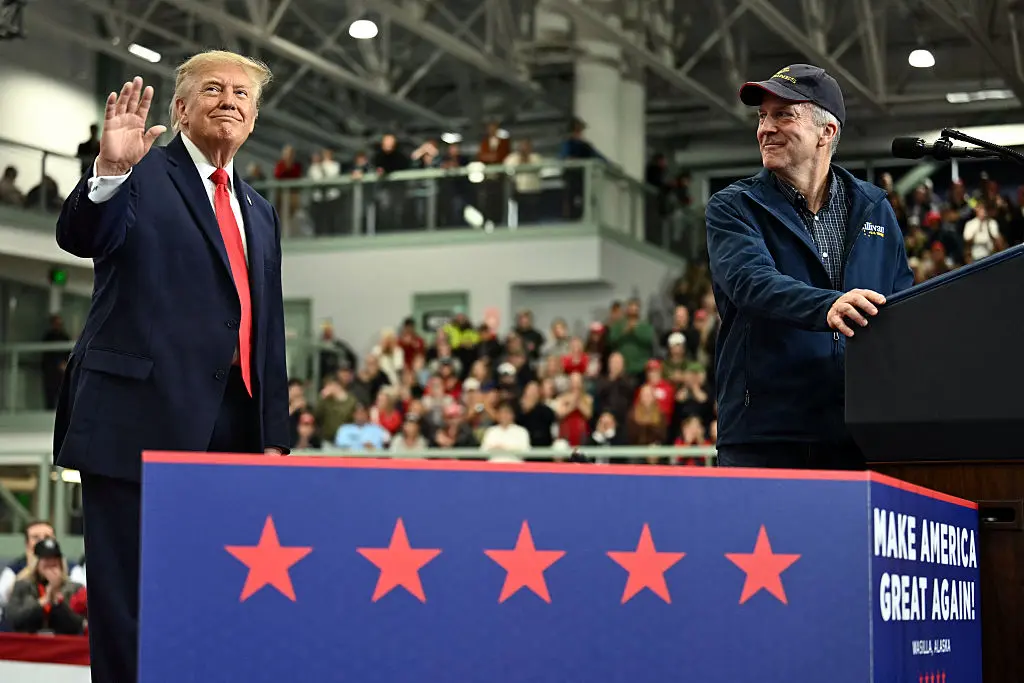
President Trump publicly underscored these anxieties on Wednesday through a post on Truth Social, stating that he was "very concerned" about the Alaska Senate race and characterizing the candidate lineup as "totally confusing." Pointing to the tightness of the margins, Trump wrote that even shifts of "1, 2, or 3%" could ultimately determine the outcome of the race. When pressed by reporters on Friday regarding the origin of the federal lawsuit, Trump openly acknowledged his role, telling reporters, "I’m the one that said do it."
The response from Alaska’s political establishment and legal experts has been swift and sharply critical. On Friday, Peltola’s campaign, alongside the Democratic Senatorial Campaign Committee, formally requested to join the federal lawsuit as defendants. In their filing, they wrote pointedly, "Alaskans, apparently, must elect Senator Dan S. Sullivan or the President will not let them elect anyone at all."
Prominent voting rights scholars have roundly condemned the action. UCLA law professor Richard Hasen dismissed the move as a "desperate and unprofessional assault" on the American electoral framework. Meanwhile, Lisa Murkowski, Alaska’s senior senator and a fellow Republican who endorsed the incumbent Sullivan in January, forcefully condemned the federal intervention on Friday.
"Alaskans don’t need any help voting for their preferred candidates," Murkowski wrote in a post on the social media platform X. "The Department of Justice should never have filed this lawsuit."
Nate Adams, a spokesperson for Dan S. Sullivan’s campaign, expressed lingering confidence in the incumbent’s ultimate victory but told local media outlet KFSK that the campaign would simply "let the DOJ complaint run its course." Neither the Department of Justice nor the respective candidate campaigns responded to requests for comment from media organizations.
Why Experts Question the DOJ’s Alaska Election Lawsuit
The current federal lawsuit represents the latest chapter in an ongoing battle over ballot integrity in Alaska. Earlier in the election cycle, state Republicans pursued administrative avenues to disqualify Daniel J. Sullivan from appearing on the ballot altogether.
In June, complaints submitted to Carol Beecher, the director of Alaska’s Division of Elections, resulted in a preliminary determination that the challenger would be removed from the ballot. State officials argued at the time that his candidacy had not been filed "in good faith for the purpose of genuinely pursuing" public office.
However, Daniel J. Sullivan fought back, filing a lawsuit against the state in local court. Judge Thomas Matthews of Alaska’s Third District Superior Court ruled in June that the challenger was legally entitled to remain on the ballot. In a comprehensive 32-page opinion, Judge Matthews wrote that election administrators were attempting to introduce a "new, previously unstated ‘good faith’ criteria" that lacked any foundation in state statute or the Alaska Constitution. The Alaska Supreme Court subsequently upheld that ruling on June 29, cementing the decision to include both candidates while implementing the mitigating remedy of middle initials and the "incumbent" designation.
Even after the state supreme court settled the ballot composition question, scrutiny persisted. In August, reports emerged that the Department of Justice had issued grand jury subpoenas as part of an active probe into whether Daniel J. Sullivan entered the race specifically to deceive voters. The DOJ ultimately timed its civil lawsuit to coincide with October polling figures indicating a lead for Peltola.
To justify its unprecedented intervention, the federal government pointed to statutory language within the National Voter Registration Act of 1993 (NVRA) declaring that a core purpose of the law is to "protect the integrity of the electoral process." Legal scholars, however, have strongly disputed whether this broad preamble grants the executive branch the authority to meddle in state election certification.
Derek Muller, an election law professor at the University of Notre Dame, argued in a legal analysis that the proposed post-election investigation is "essentially impossible" to execute fairly. He noted that the true objective of the litigation may extend far beyond the specific outcome in Alaska.
"The legal claim is so absurdly thin, there’s essentially no likelihood of success," Muller wrote, suggesting the litigation is primarily intended to signal to the public that the administration stands prepared to challenge unfavorable midterm results wherever they occur.
David Becker, executive director of the nonpartisan Center for Election Innovation and Research, echoed those sentiments, calling the move entirely "unprecedented."
"I cannot recall an administration ever attempting to stop the certification of an election—and certainly not 11 days before polls close," Becker said in a public statement. "Furthermore, this issue has already been fully litigated by Alaska’s courts. Alaska election officials are following state law, as the Constitution requires, and the courts will uphold that."
Civil rights organizations have also mobilized against the federal filing. Common Cause, represented by the American Civil Liberties Union, filed a motion on Friday to intervene in the case in opposition to the Justice Department. Virginia Kase Solomon, the organization’s president and CEO, emphasized the core principle of voter sovereignty, stating, "Politicians don’t dictate election outcomes; the people do."
How the Federal Government Has Used the National Voter Registration Act
Enacted in 1993, the National Voter Registration Act was originally designed to dismantle systemic barriers to voter registration that historically suppressed voter turnout and disproportionately impacted racial minorities. The statute rests upon the fundamental premise that every eligible citizen possesses an inherent right to vote, coupled with a governmental obligation to safeguard that participation.
Over the past three decades, successive presidential administrations have utilized the NVRA primarily to compel states to maintain accurate voter rolls or adhere strictly to federal registration mandates. In 2022, the Biden Administration reached a settlement with Alaska after finding that the state failed to consistently offer voter registration services or updates during routine transactions at the Department of Motor Vehicles.
Similarly, the Obama Administration filed a lawsuit against Florida in 2012 over an aggressive state program aimed at purging suspected noncitizens from voter rolls too close to a federal election, a case that was ultimately dismissed following a negotiated agreement. The George W. Bush Administration also leveraged the NVRA on multiple occasions to enforce compliance regarding mail-in registration applications and list maintenance standards.
Legal analysts emphasize that the Justice Department’s current action in Alaska far exceeds any historical precedent under the NVRA. Walter Olson, a senior fellow at the libertarian Cato Institute, warned that if federal courts validate the administration’s expansive interpretation of the statute, the consequences could fundamentally alter the American electoral landscape by federalizing routine aspects of local administration.
"It attempts to stretch a federal statute, the National Voter Registration Act, beyond recognition by snipping language from the law’s preamble and treating it as if it creates vast and open-ended new duties that the federal government can enforce on states," Olson said. "If accepted, it would suddenly federalize many issues of local election administration."








No comments yet. Be the first to join the conversation!