
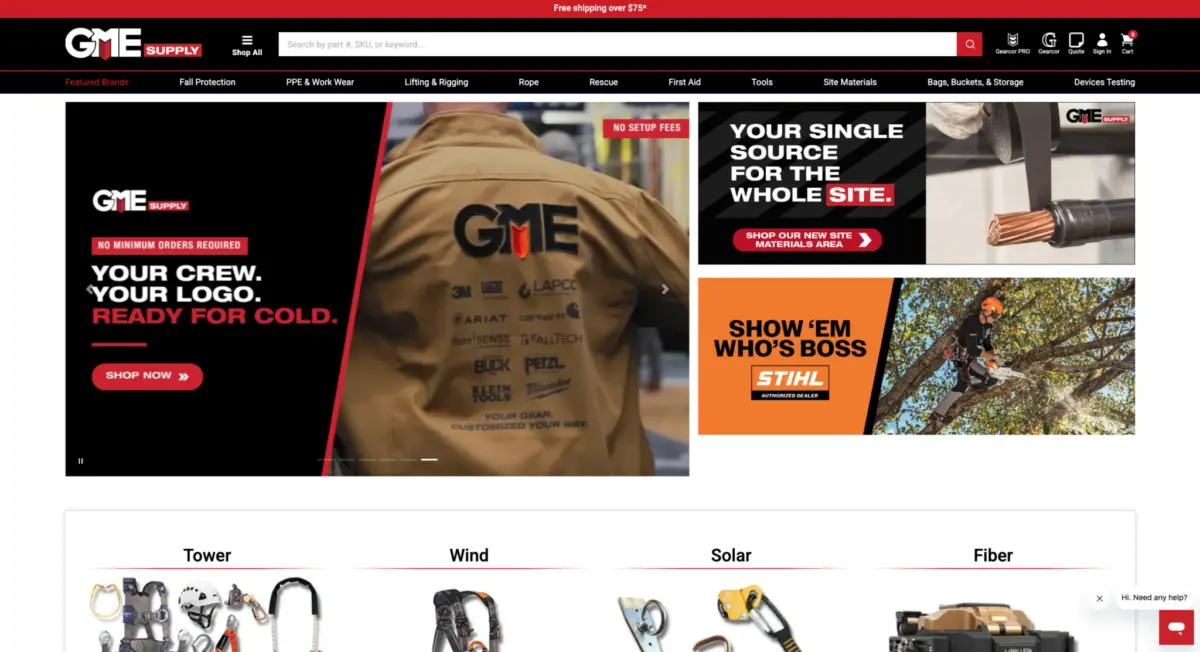
Two prominent Midwestern workplace safety and industrial equipment distributors have officially joined forces following a strategic acquisition. GME Supply, a major distributor headquartered in Columbia, Missouri, has announced the acquisition of Commercial Supply Co. (CSC), a well-established competitor based in Des Moines, Iowa. The transaction brings CSC and its robust regional portfolio directly under the GME Supply corporate umbrella, marking a significant step in the ongoing consolidation of the regional industrial supply and safety equipment market.
The acquisition extends GME Supply’s operational reach deeper across the Midwest while simultaneously expanding its product inventory and specialized offerings. Commercial Supply Co. has built a solid reputation primarily serving construction and industrial contractors, providing them with essential tools, gear, and specialized products. Through this deal, GME inherits valuable inventory lines, including specialized items such as cable-wrapping equipment and heavy-duty industrial textiles, which will immediately enhance its existing catalog. Furthermore, continuity of leadership is a key component of the transition, as Commercial Supply’s two co-owners, Brad Lilienthal and Jason Curry, will join the GME team to help guide the integration and future growth of the combined enterprise. Terms of the financial transaction were not publicly disclosed by either party.
Why GME Supply is Acquiring Commercial Supply Co.
Leadership from both organizations have outlined clear strategic motivations behind the union, emphasizing mutual benefits for customers, employees, and suppliers alike. Ryan Keogh, chief executive officer of GME Supply, pointed to Commercial Supply’s stellar reputation within the contractor community as a primary driver for the acquisition.
According to Keogh, Commercial Supply has successfully carved out its niche by deeply understanding the day-to-day needs of contractors and consistently delivering reliable solutions that keep complex projects moving forward on schedule. He noted that CSC’s industry expertise, deeply rooted customer relationships, and entrepreneurial business approach represent a natural philosophical and operational fit with GME Supply. By bringing these two forces together, Keogh believes the company will be in a position to offer customers significantly broader capabilities, vastly improved access to inventory, and the deeper institutional resources required to support large-scale projects across an expanding array of markets.
Echoing these sentiments, Brad Lilienthal praised the acquisition as a major win for both the company’s existing customer base and its workforce. Lilienthal emphasized that joining forces with GME Supply unlocks exciting new growth opportunities. By leveraging GME’s broader range of products, robust corporate resources, and extensive national distribution network, the team from Des Moines will be able to build meaningfully upon the foundation they have already established, ultimately serving a larger volume of customers across a wider geographic footprint.
This acquisition also dovetails neatly into a sophisticated digital operation that GME Supply has steadily constructed over recent years. GME operates advanced e-commerce platforms, including GME.com and FWLSP.com, which feature specialized ordering systems engineered specifically for large-scale, enterprise-level customers. In a 2024 interview with Industrial Supply Magazine, Keogh described his company as resolutely "digital first." Additionally, GME owns Gearcor, a specialized software platform that enables corporate clients to manage employee uniforms, personal protective equipment (PPE), and fall protection gear through private online marketplaces equipped with comprehensive manager dashboards.
Business Implications for the Acquisition
Industry analysts examining the transaction have noted that the move aligns perfectly with broader trends in private equity and industrial distribution. Alex Stepansky, founder of Corridome—a specialized database tracking U.S. private equity firms, mergers and acquisitions, and industry deals compiled from public records—provided deeper context regarding the mechanics of the transaction.
Stepansky pointed out that GME Supply is backed by Incline Equity Partners, a Pittsburgh-based private equity firm. Viewed through this lens, the acquisition of Commercial Supply Co. functions as a classic add-on strategy: a private equity-backed distribution platform acquiring a smaller, highly competent regional competitor. Stepansky explained that executing a bolt-on acquisition of this nature frequently makes immense financial and operational sense within the distribution sector.
Acquiring an established regional distributor instantly provides the parent company with physical branches, active contractor accounts, and valuable supplier lines that would otherwise take years of organic effort and capital expenditure to build from scratch. Furthermore, smaller independent distributors routinely trade at lower multiples of earnings compared to larger national platforms. Consequently, each successful add-on acquisition progressively increases the overall valuation and potential future selling price of the entire parent company when ownership eventually decides to exit.
When Incline Equity Partners initially acquired a stake in GME Supply in 2023, leadership signaled a clear intent to heavily invest in upgrading and expanding the company’s proprietary online ordering infrastructure. Stepansky noted that for the everyday customer, the tangible impacts of such corporate maneuvers usually manifest online first. Typically, the customer base and purchasing accounts of the smaller acquired entity are systematically migrated onto the parent company’s centralized ordering portals and expansive product catalogs.
Why Digital Strengths are Important
The integration of digital capabilities represents both the greatest opportunity and the most delicate challenge of the acquisition. Mike Danford, owner and chief revenue officer at Adverio—an omni-marketplace operator that manages e-commerce operations for various brands—highlighted that the digital infrastructure is precisely what GME brings to the broader partnership.
Danford emphasized GME’s advanced technological footprint, noting its proprietary purchasing platform, GME PRO, and the managed-gear program operating under the Gearcor brand. These systems allow commercial contractors to establish strict company-wide allowances and pre-approved product catalogs, enabling individual crew members to order their required personal protective equipment directly from their mobile phones.
At the same time, Danford observed that Commercial Supply brings valuable specialty contractor accounts—particularly within the burgeoning solar and wind energy sectors—whose field crews require precise, specialized gear. The true commercial value of the acquisition lies in successfully migrating these specialized accounts onto GME’s advanced technological systems while keeping the trusted Des Moines team visible as the primary face of the operation.
However, Danford also cautioned that the most hazardous phase of any such transaction is the migration period. Citing data from brands he manages, Danford noted that business-to-business buyers already account for 8% to 9% of sales catalog-wide, and roughly 20% within specific niche categories. When a distributor disrupts the ordering process, it risks operational friction. The months immediately following an acquisition represent a vulnerable window where frustrated procurement managers might be tempted to experiment with alternative digital channels, such as Amazon Business, for the very first time.
If a contractor is forced to relearn how to place routine orders, competing e-commerce marketplaces stand ready to siphon away new and existing business. Danford emphasized that the deal will perform optimally only if it functions as a seamless merger where the customer experiences virtually zero disruption. The ideal transition maintains the same sales representatives, the same credit terms, and the same reliable delivery trucks. Conversely, integration efforts typically falter if the customer’s first noticeable encounters are a mandatory new login portal, unexpected price hikes, or favorite products quietly disappearing from the streamlined catalog. As Danford succinctly observed, professional contractors rarely switch their trusted distributors over corporate mergers; rather, they switch the exact week an essential order fails to arrive on time.










No comments yet. Be the first to join the conversation!