
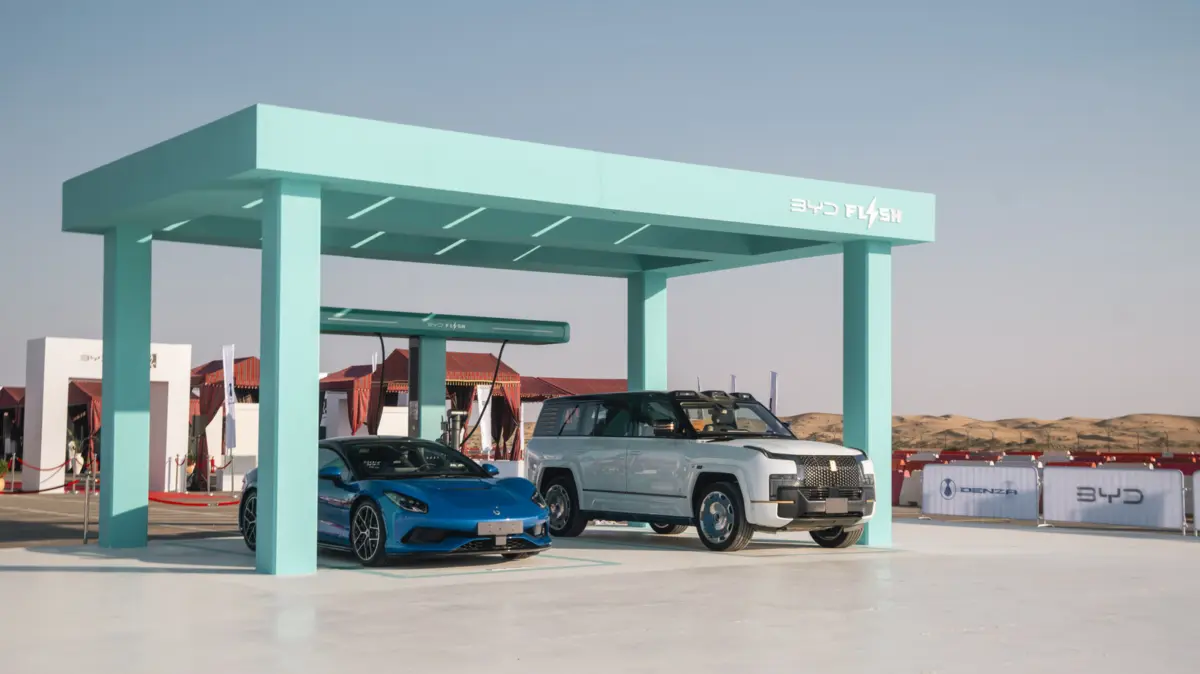
Despite not selling any consumer vehicles in the United States, China’s BYD is quietly executing a massive, global takeover of the electric vehicle landscape. The company has officially surpassed Tesla as the world’s largest electric carmaker by global sales volume, a monumental milestone that underscores the rapid shift in the international automotive market. Having already captured the crown for vehicle production and sales, BYD is now hard at work attempting a secondary conquest: dethroning Tesla as the provider of the world’s most advanced and widespread electric vehicle charging network.
Now, the company has announced the latest and most ambitious step toward achieving that ultimate goal. In an announcement originating from the United Arab Emirates, BYD revealed that it has successfully combined clean solar power generation, its proprietary Flash Charging technology utilizing localized energy storage, and automated robotic charging arms into a single, cohesive electric vehicle charging ecosystem. This groundbreaking infrastructure project was officially introduced in the harsh and demanding environment of the Abu Dhabi desert, signaling the company’s readiness to deploy advanced technological solutions in extreme climates.
The technological core of this new system is BYD’s proprietary Flash Charging architecture. Like a conventional electric vehicle charging station, the infrastructure draws electrical power directly from the main utility grid. However, the similarities end there. Instead of feeding that grid power directly into a waiting vehicle—a method that can be bottlenecked by local grid capacity—BYD’s station routes the electricity into two on-site, 185-kilowatt battery storage units. This localized energy buffer allows the station to accumulate energy over time and discharge it at an exponentially higher rate when an electric vehicle plugs in. That stored energy can then be pumped into a compatible EV significantly faster than it would be if the vehicle were drawing power straight from a standard grid connection, according to specifications provided by BYD.
The performance metrics of this Flash Charging hardware represent a staggering leap forward compared to current industry standards. Each individual Flash Charger is equipped with two connectors. When only a single connector is in active use, the system is capable of delivering an astonishing charging output of up to 1,500 kilowatts. If two electric vehicles are plugged into the same station and sharing the available infrastructure, the system still manages a massive output of up to 1,000 kilowatts per vehicle.
To put these figures into proper perspective within the current global charging landscape, Tesla’s newly introduced V4 Superchargers currently top out at an output of 500 kilowatts. Meanwhile, Tesla’s standard, widespread Superchargers typically hit a maximum of 250 kilowatts, and the fastest direct-current fast chargers deployed by major networks like Electrify America generally max out at 350 kilowatts. BYD’s system leaves these figures far behind, publishing estimated charge times that sound almost futuristic. According to the manufacturer, the Flash Charging system can replenish a compatible vehicle’s battery from 10 percent capacity to 70 percent capacity in a mere five minutes. A charge from 10 percent to 97 percent takes just nine minutes. Perhaps most impressively, even in severe cold weather conditions—tested at an ambient temperature of minus 30 degrees Fahrenheit—the system can successfully take a battery from 20 percent to 97 percent capacity in only 12 minutes.
Solar-powered arms race
Building upon the raw power of its localized battery storage units, BYD is now incorporating clean solar generation directly into the equation. The system draws renewable power from the sun, funneling that solar energy directly into the same local 185-kilowatt battery reserves. While official deployment details are still unfolding, this solar harvesting is presumably facilitated through solar panels placed strategically on top of the charging station’s protective architectural canopy.
This integration means the entire charging ecosystem operates with a significantly reduced reliance on the traditional electrical grid. Such a feature is critically important in remote, sun-soaked regions across the globe—such as the unforgiving desert landscape of the United Arab Emirates where BYD chose to launch this groundbreaking technology. By harvesting abundant local sunlight and storing it efficiently in high-capacity batteries, the stations can operate reliably even in areas with underdeveloped or fragile grid infrastructure.
The final pillar of this comprehensive charging station design is the integration of automated robotic arms. While the concept of a robotic charging assistant is far from brand new or entirely original—Tesla famously promised robotic charging snake arms a decade ago, and established automakers like Volkswagen, Hyundai, and China’s Xiaomi have since built their own conceptual and working renditions over the years—BYD is bringing the technology into a commercially viable, integrated field deployment.
The underlying premise remains elegantly simple: a mechanical robotic arm utilizes advanced sensors and spatial mapping to accurately locate a vehicle’s charging port, automatically open the protective cover flap, and securely insert the heavy high-power connector without requiring any physical effort from the driver. In extreme weather environments, whether facing scorching desert heat or sub-zero winter freezes, removing the need for a human driver to handle thick, heavy, high-voltage cables is a notable ergonomic and safety improvement.
Looking toward the immediate future of its global infrastructure expansion, BYD has laid out an aggressive deployment schedule. The company officially plans to manufacture and install 6,000 of these advanced Flash Charging stations worldwide before the end of next year. Industry analysts note that consumers should not expect all, or even a majority, of these initial deployments to feature solar generation arrays or automated robotic arms right out of the gate, as local installation requirements and site economics will vary. However, if BYD can successfully execute its roadmap and truly normalize five-minute ultra-fast charging backed by solar energy and robotic assistance sometime over the next couple of years, the automotive industry may well be witnessing the rise of a formidable new king in the global EV charging network race.








No comments yet. Be the first to join the conversation!